Why we study pictures within pictures
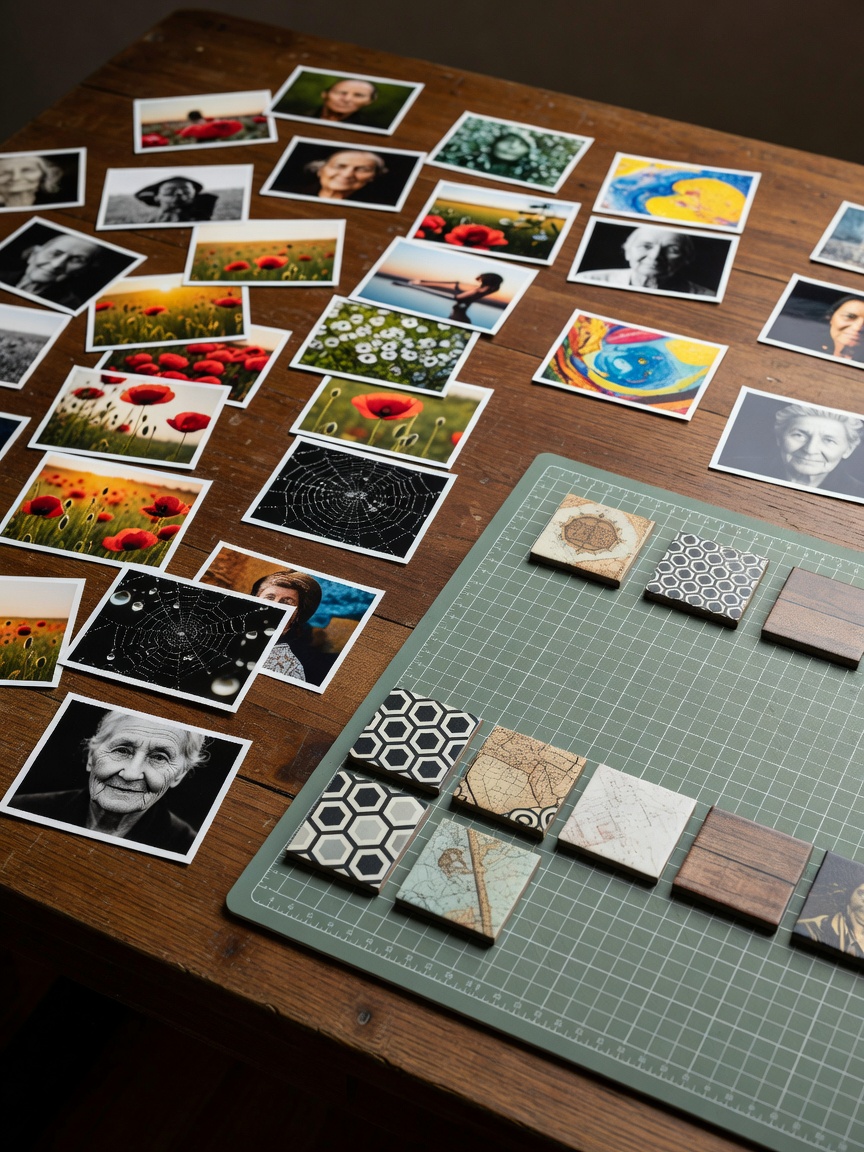
We're a small, independent team of photographers and printmakers fascinated by one idea: that a crowd of tiny images can agree on a single larger one.
A long lineage
- Stone tesserae
The Alexander Mosaic from the House of the Faun in Pompeii and the glittering apse of San Vitale in Ravenna show how small units of colour build a commanding image.
- Composite heads
Giuseppe Arcimboldo's 16th-century portraits assembled from fruit and books play the same two-distance game.
- Computer pictures
Leon Harmon and Ken Knowlton's "Studies in Perception I" (Bell Labs, 1966) built a nude from symbols; Harmon's blocky Lincoln inspired Salvador Dalí's 1976 painting of Gala that becomes Lincoln from twenty metres.
- Photomosaics
In the 1990s, Robert Silvers, working from the MIT Media Lab, popularised mosaics built from real photographs, and Chuck Close's grid portraits made the idea familiar in galleries.
How we write
We test software on our own photo collections, print proofs, and stand at different distances from the results, often with a tape measure. When we give numbers, such as tile sizes or tint percentages, we present them as starting points, because subject matter and lighting change everything.
We're honest about trade-offs. Some photographs make striking mosaics; others are better as tiles. We'd rather tell you that before you order a large print than after.
Independence
We aren't affiliated with any software developer or print lab mentioned on this site, and we don't accept payment for placement in our comparisons. Product details change, so we encourage you to confirm features and prices on developers' own websites.
What we don't do
We don't upload, store or process your photographs, and there is no mosaic generator on this site. Everything here is guidance for making mosaics with your own tools.